
Estimates of real military spending for 2024, in terms of military purchasing power parity (mPPP) are now available, thanks to recent updates by SIPRI and IISS.
The data show significant gaps between military spending measured at market exchange rates and military spending estimated in terms of what it can purchase at local prices.
The differences are driven largely by currency undervaluation, in terms of tradable goods, and differences in the costs of non-tradables due to differences in labour costs. These mean that comparing military spending across countries at market exchange rates will typically understate the real purchasing power of a country’s defence budget in middle income and low income economies.
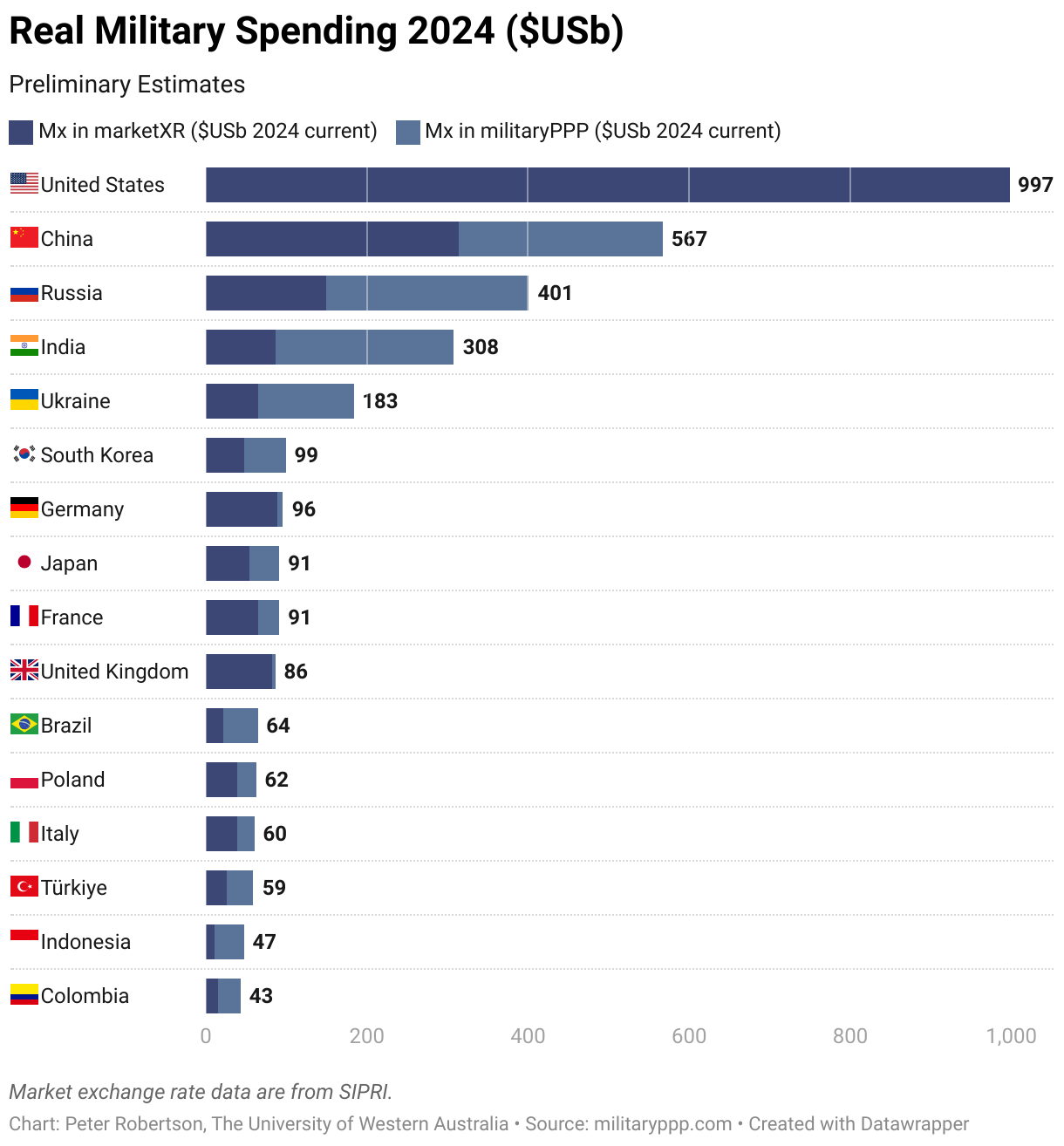
The gap is especially notable for larger spending countries such as China, Russia India and Ukraine. But market exchange rate estimates also appear to underestimate real military spending for many European countries particularly Poland, Italy and Turkey.
Using military PPP adjustments, China’s military spending increases from a market exchange rate estimate of $313b to $567b, which is approximately 57 percent of the USA. China’s slowing economic growth has seen the USA matching China’s military spending growth in recent years, albeit at the cost of a much higher US defense burden.
For further discussion of the trend in China’s military spending see my discussion in VoxEU.
As noted by SIPRI and IISS, and as discussed in this week’s Economist Magazine, Russia’s military spending surged in 2024. In military ppp terms it is now estimated to be approximately $400b, or 34% of the USA. This much larger than the market exchange rate value of $148b.
In nominal terms Russian military spending increased by 49 percent, from 9.3b rubles to 13.8b rubles. In military purchasing power terms the 2024 figure of $400.8b represents a more reasonable, but still very large, 28 percent increase on the previous years figure of $314b. While very preliminary, this suggests part of the nominal spending surge reflects rising costs.
Real military spending for all countries in the sample are given below.
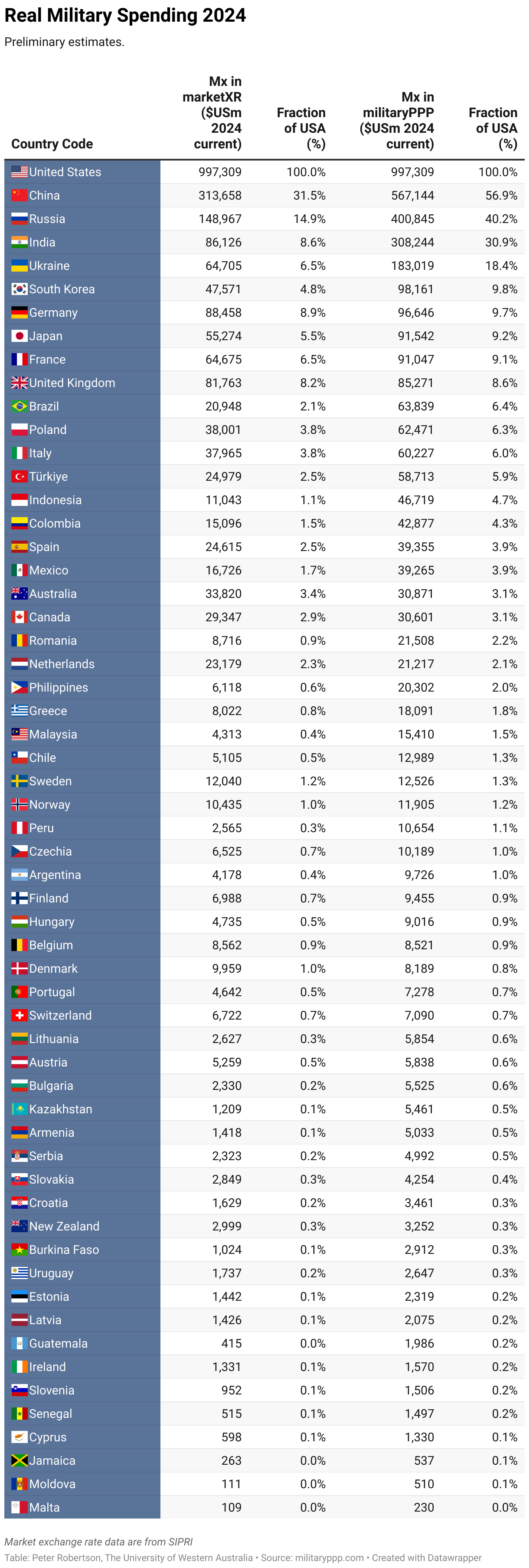
While the data are carefully constructed they are approximations and user discretion is advised. The data are also preliminary estimates will be updated latter in 2024 when more source economic data is released.
Since the data depend on the reporting of defence budgets to the UN, estimates are not currently available for Saudi Arabia, Israel, Pakistan, Taiwan, Kuwait, Iran and Iraq, among others.
A data spreadsheet for 2024 and previous years is also available on the Data Page.
Thanks to SIPRI and IISS for their support.
.
 militaryppp.com
Dear Professor Robertson,
I have a question regarding your military-PPP calculations for Japan. Your data shows Japan has a military-PPP/market exchange rate ratio of 1.65, which seems counterintuitive given Japan’s notoriously high domestic prices for services and operations.
Could you clarify how Japan’s high internal costs (particularly for the Operations component, which represents 41% of their defense budget) result in higher purchasing power rather than lower? I would expect countries with expensive domestic services to have ratios below 1.0, not above.
What specific factors drive this seemingly paradoxical result for Japan?
LikeLike
Thank you for your interesting question. First look at ICP’s GDP-PPP for Japan, which measures average price differences with the USA. This is 95 yen per dollar compared to the market exchange rate of 151 yen per dollar (data here https://databank.worldbank.org/source/icp-2021). Some goods such as transport are very expensive (244 yen per dollar) while others such as construction (89 yen per dollar) or health (51 yen per dollar) are very affordable. So notwithstanding the fact that some services are very expensive, your dollar still goes further in Japan on average. In part this is due to what could be described as an undervaluation of the yen in terms of traded goods – which is why tourism is booming.
The ICP exchange rate for Machinery and Equipment is 128 yen per dollar – still lower than the exchange rate. So while more expensive than some goods, equipment is cheaper in Japan which again reflects the low value of the yen. This matters for military-PPP
Labour costs in Japan are also relatively affordable – which is reflected in the lower cost of sectors such as health and construction. It is is also reflected in the defense budget where Japan has around 262 thousand personnel for what is a relatively small personnel budget when measured at market exchange rates. It suggests a personnel PPP exchange rate of 65 yen per dollar (after adjustmnets for labour productivity differences). So a combination of the low value of the yen and low relatively labour costs faced by the defense sector drive the higher military PPP adjusted value of its defense spending, where the military-PPP exchange rate is 92 yen per dollar, close to the GDP-PPP exchange rate.
LikeLike